The 10 Best AP Automation Solutions in 2026 (And Why the Category Is Shifting to Agentic Intake-to-Pay)
The 10 best AP automation solutions for 2026, Tipalti, Stampli, BILL, Ramp, Coupa, Zip, Blackbee AI and more, compared by best fit, ERP, and pricing.
Key Takeaway
"AP automation" is becoming a feature, not a category. The durable value is moving upstream, to the agentic layer that captures spend at intent, reasons about every transaction in context, and acts autonomously with a full audit trail. This guide compares the 10 strongest platforms on the market in 2026, organised from established AP automation through to the emerging agentic Intake-to-Pay layer.
AP has quietly become one of the most expensive manual processes in mid-market finance
Research from Ardent Partners puts the average invoice at 17.4 days and $12.88 to process without best-in-class automation, while best-in-class teams do it in 3.1 days at $2.78. IFOL found that 63% of AP teams still spend more than 10 hours a week keying data and chasing approvals.
The hard part was never reading the invoice
The hard part of AP was never reading the invoice. It was everything around it: matching it to a contract, deciding whether the price drift is acceptable, routing it to the right approver, catching the duplicate, posting it cleanly to the ERP. Most "AP automation" software was built to digitize the easy part and hand the judgment back to a human.
The category is splitting
That's changing fast. In 2026, the category is splitting into two layers. There are the established AP automation platforms that capture, code, route, and pay, and they're genuinely good at it. And there's an emerging agentic layer that starts upstream at the moment spend intent is requested (not when the invoice lands), reasons about each transaction in context, and acts autonomously with a full audit trail. Wolters Kluwer projects that 44% of finance teams will use agentic AI in 2026, a roughly 600% jump year over year.
How to read this list
This guide covers ten of the strongest solutions on the market, organized roughly from the most established players to the emerging agentic category. It is not a strict quality ranking, the right tool depends entirely on your size, your ERP, and how much judgment you want the software to carry. Use the comparison table near the end if you want the short version.
What to evaluate in an AP automation solution
Before the list, here's the framework we used, and a useful checklist for your own shortlist. Strong solutions are measured on:
- Invoice capture accuracy: how reliably it extracts header and line-item data from messy, real-world documents.
- Approval workflows: whether routing is just amount-based, or genuinely policy- and risk-based.
- ERP integration: depth and reliability of the sync with NetSuite, Sage Intacct, Dynamics 365, Workday, SAP, or QuickBooks.
- Payment execution: domestic and global rails, and how payment timing is managed.
- Exception handling: what happens when an invoice doesn't match. This is where most platforms stop and most teams struggle.
- Upstream intake: whether the tool only sees the invoice, or captures spend at the point of intent.
- Explainability and audit: whether every decision is traceable and defensible at audit time.
- Autonomy: how much the system decides versus how much it routes back to a human.
- Best-fit company size: SMB, mid-market, or enterprise.
1. Tipalti: best for global mass payments
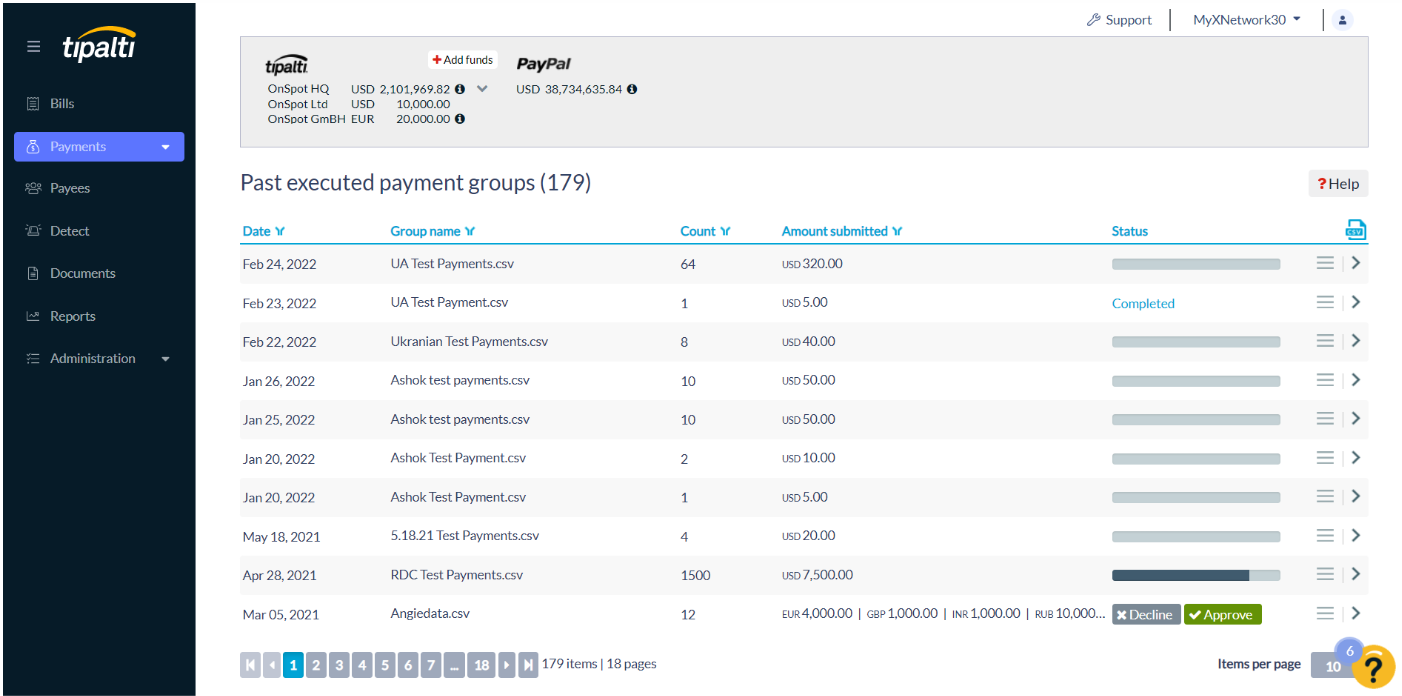
Tipalti is the platform of choice when payment complexity is the real problem. It supports payments across roughly 196 countries in 120+ currencies, with KPMG-validated tax compliance, supplier-managed onboarding portals, and W-8/W-9 collection and 1099 e-filing built in. For finance teams paying large international vendor or contractor bases, that payment infrastructure is hard to beat. The trade-offs are cost and complexity. Pricing starts around $99/month, but the full global feature set sits on higher Advanced tiers, and several reviewers note that the OCR can struggle on basic capture and that procurement and AP feel like separate modules. Best for: mid-market and enterprise teams with heavy cross-border payment needs. Native integrations include NetSuite, Sage Intacct, SAP, Dynamics 365, and QuickBooks.
2. Stampli: best for invoice-centric collaboration
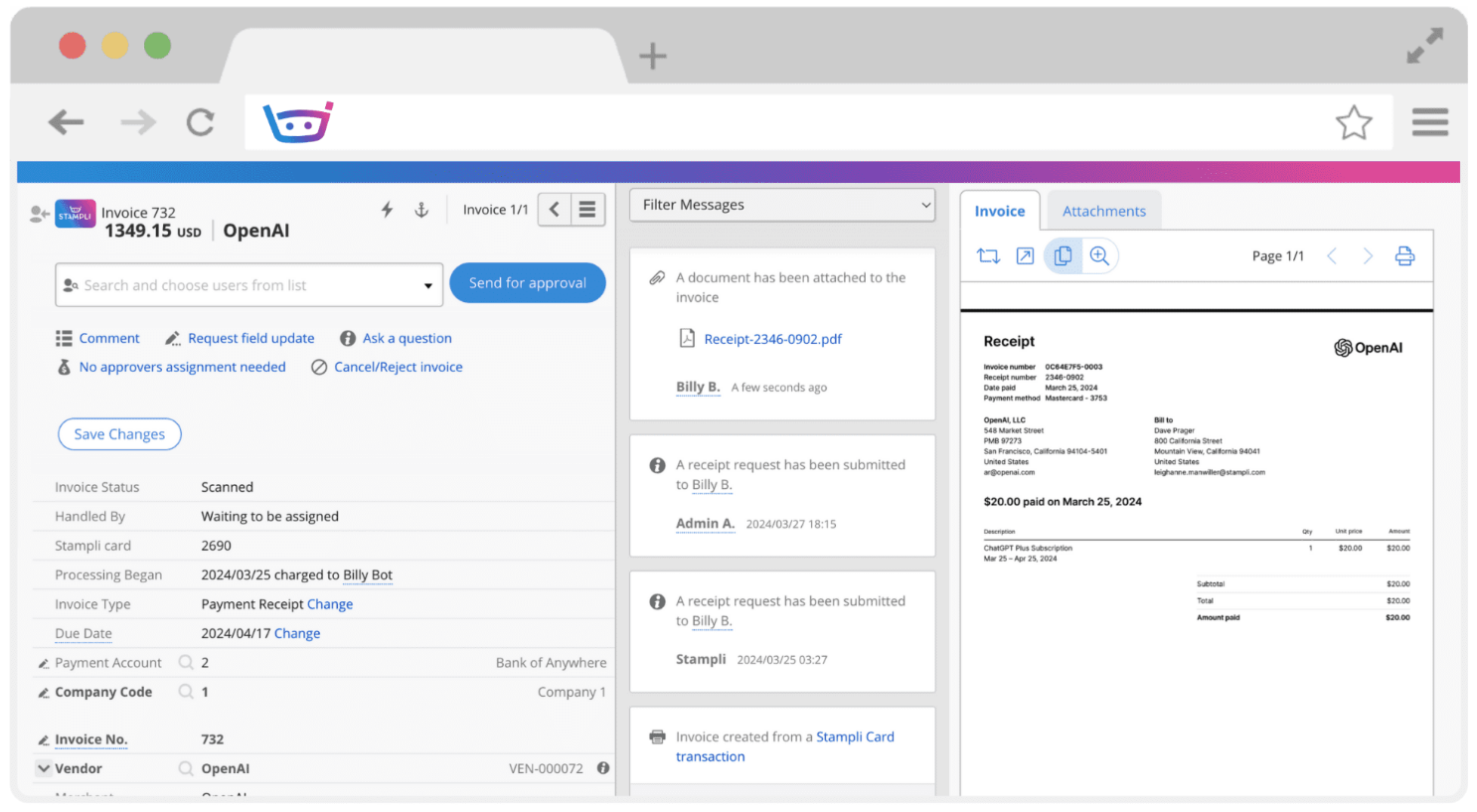
Stampli is built around a simple, effective idea: put every conversation, document, and approval directly on the invoice itself. Its AI assistant, Billy the Bot, suggests GL codes from historical patterns, learns from corrections, flags duplicates, and automates routing. With well over 1,600 customers and a large processed-spend dataset behind the model, plus a 4.6+ G2 rating across nearly 1,900 reviews, it's one of the most consistently praised tools in the category. Stampli adapts to your existing process rather than forcing a redesign, and its NetSuite integration earns specific praise. Implementation typically runs 4 to 6 weeks. Payments outside the US lean on partners rather than native global rails. Best for: growing mid-market teams that want deep ERP integration and collaborative approvals without a heavy rebuild.
3. Zip: best for agentic procurement orchestration
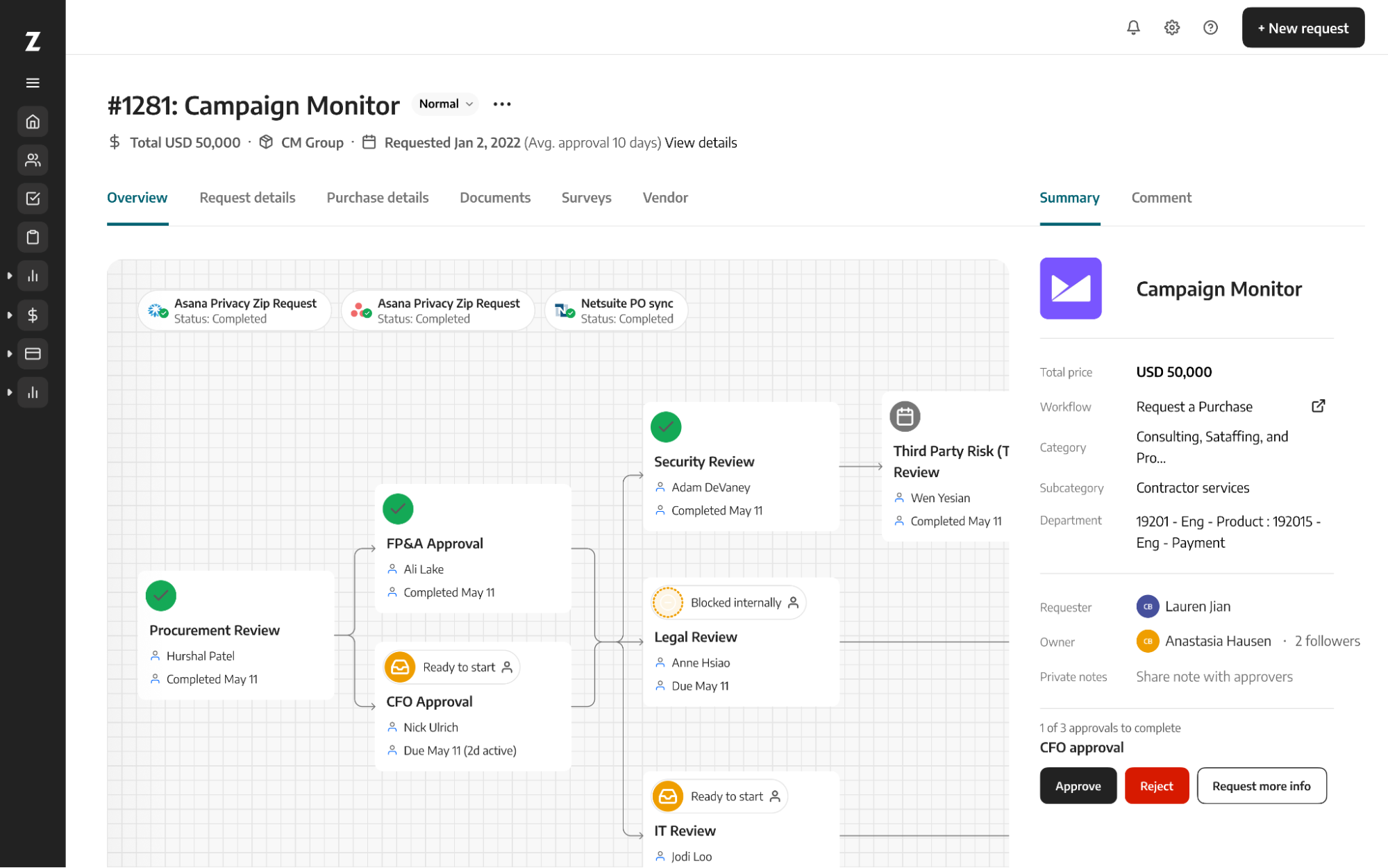
Zip is the first solution on this list built around a fundamentally different premise: control is won upstream, at intake. It gives employees a single front door to request any purchase, captures the relevant details before any commitment is made, and routes the request through no-code, policy-aware approval workflows, then connects to existing financial systems for execution. Its AI extracts invoice data and matches it to POs downstream. Zip has leaned hard into the agentic shift, launching "Superagents" and a library of purpose-built AI agents for sourcing, risk, and procurement tasks; it approved over 14 million requests in 2024 and expects a meaningful share to be handled autonomously by agents going forward. It spans mid-market to enterprise and outscores Coupa on G2 among mid-market reviewers. Best for: procurement-led organizations that want to orchestrate spend from the first request. Zip is procurement-first; the next entry approaches the same upstream philosophy from the finance and control side.
4. Blackbee AI: best for agentic Intake-to-Pay above your ERP
Here's where the category framing matters. Blackbee AI is not AP automation in the traditional sense, and it's worth being precise about that, because the distinction is the entire point. Most tools on this list start at the invoice. Blackbee starts at spend intent, the moment a request is made over email, Slack, a vendor portal, or any informal channel, which is exactly the 40 to 60% of enterprise spend that Ardent Partners found bypasses formal procurement workflows entirely.
How the eight agents map to the cycle
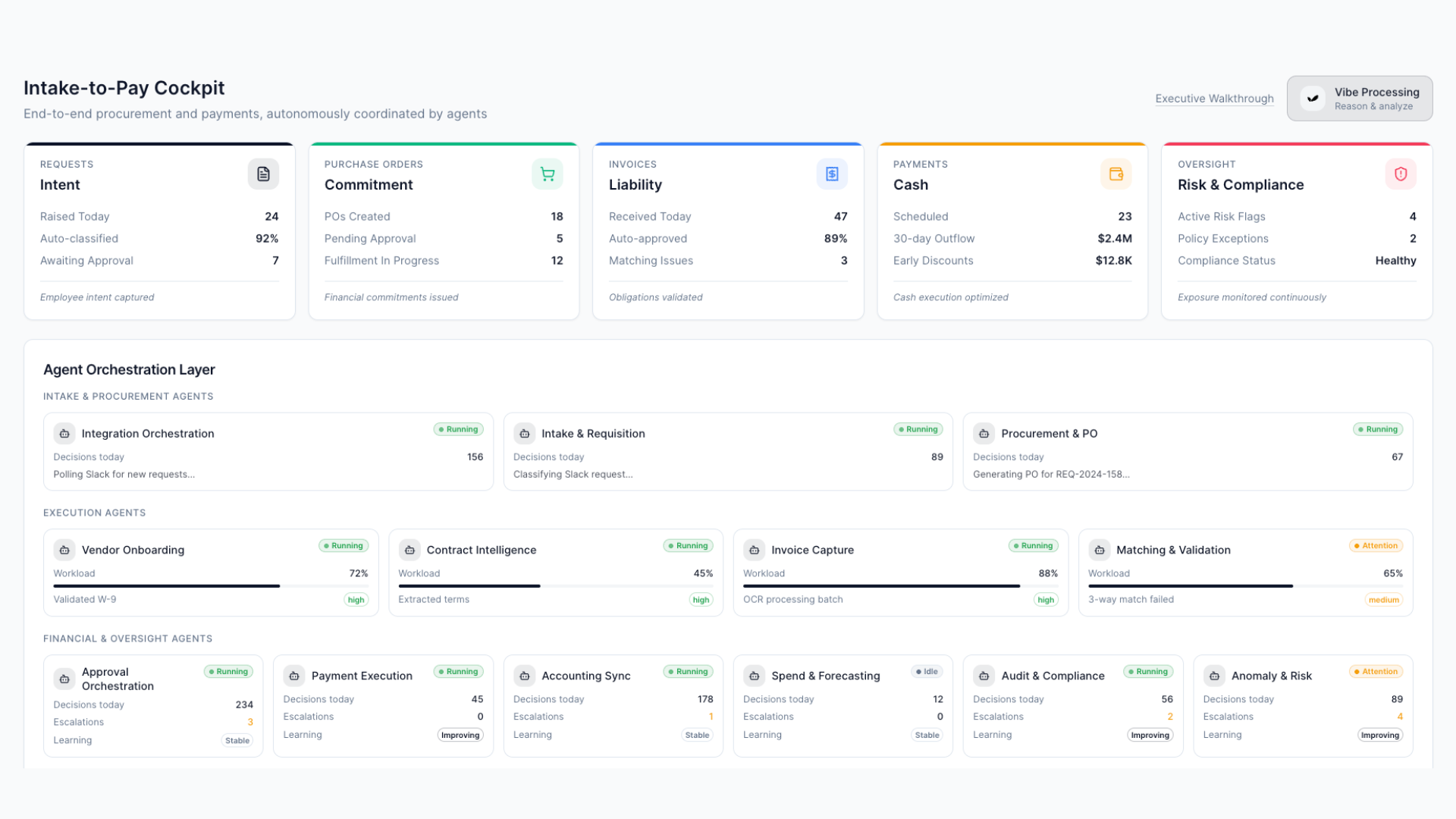
Blackbee AI is an agentic Intake-to-Pay platform: a decision and control layer that sits above your ERP, not instead of it. Eight specialist AI agents own the cycle, Intake captures requests before commitment, Commit governs PO creation, Clause turns contracts into live financial guardrails, Route orchestrates approvals by risk and policy (not just amount), Trust handles vendor onboarding and continuous vendor risk scoring, Parse validates invoices with contract-aware three-way matching, Signal delivers spend forecasting and anomaly detection, and Sync posts validated decisions back to the ERP. Where legacy AP automation routes a document and asks a human to judge the exception, Blackbee's agents reason about it, and explain every decision for audit.
Who it's built for
It integrates with NetSuite, Sage Intacct, Dynamics 365, Workday, and SAP, and is built specifically for mid-market finance teams (roughly 200 to 2,500 employees) processing 200+ I2P cycles a month who have outgrown document-level automation. Best for: CFOs and controllers who want autonomous, explainable control over the entire intent-to-payment lifecycle, not just faster invoice entry.
5. BILL: best for SMB AP and AR together
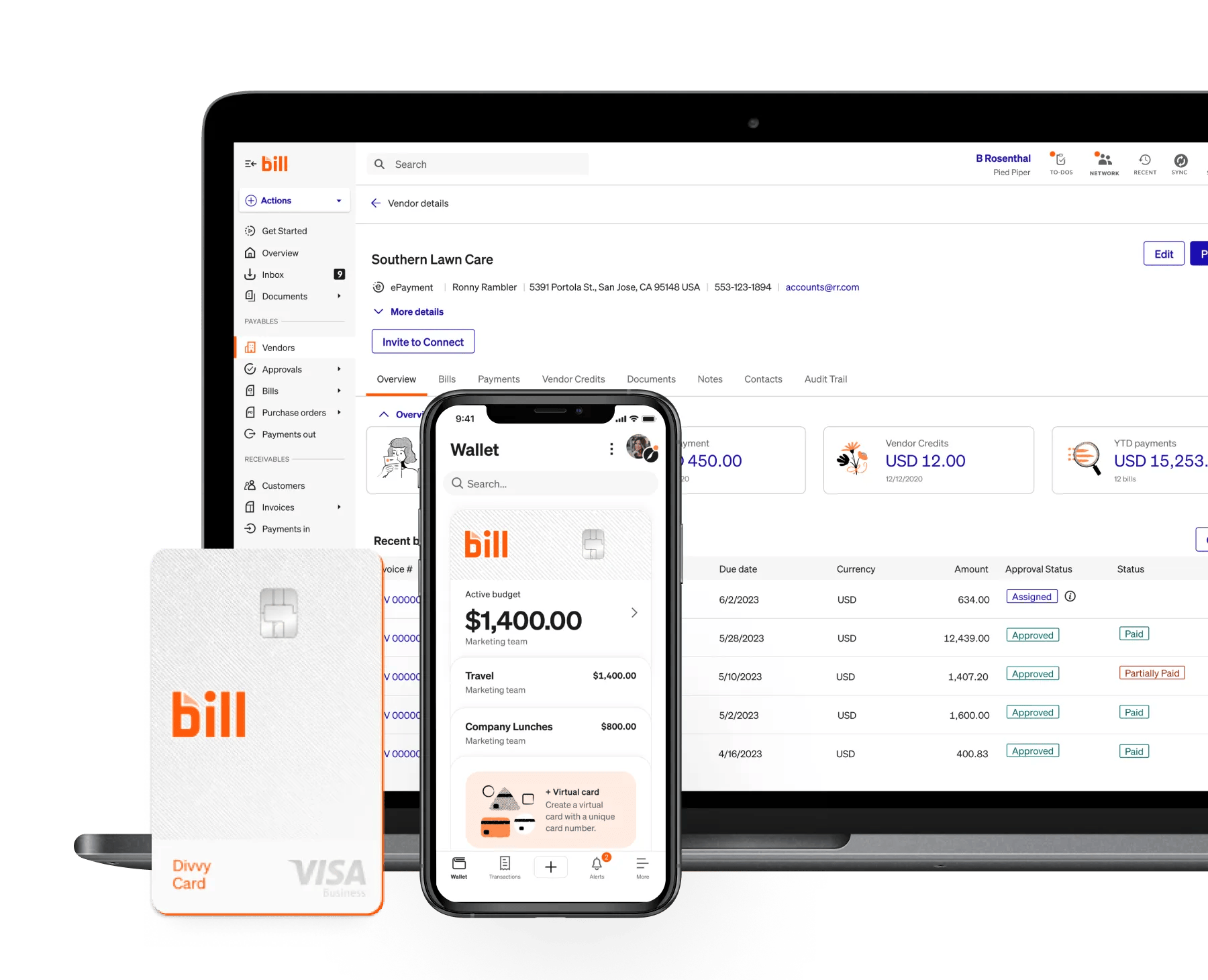
BILL (formerly Bill.com) is the default for small and lower-mid-market businesses, especially those on QuickBooks. Its strength is combining payables and receivables in one system, with configurable approval workflows, AI-assisted data capture, ACH/card/international payments, and a strong mobile approval experience. It holds a 4.4 to 4.5 G2 rating with high recommendation rates. Per-user pricing starts around $49/user/month. It's simpler and more affordable than enterprise-grade tools, which is precisely the appeal, though teams with complex, multi-entity or PO-heavy workflows tend to outgrow it. Best for: SMBs that want one tool for both sides of cash flow.
6. Ramp: best for an all-in-one US finance stack
Ramp has moved aggressively into AP, bundling invoice automation and bill pay with corporate cards, expense management, and procurement in one clean interface. It markets line-item-accurate OCR (it cites 99% accuracy), touchless processing, and automated approval routing, with a free tier and Ramp Plus from around $15/user/month. The catch is geography: Ramp is built for US companies, so international payments and compliance are limited, and some reviewers find reporting shallow compared with enterprise tools. Best for: US-based teams that want cards, spend, and AP unified in a single modern platform.
7. Coupa: best for enterprise business spend management
Coupa isn't really an AP tool, it's a full source-to-pay / business spend management suite for large, global enterprises with complex procurement. It manages the entire purchasing lifecycle with AI-driven insights and unifies spend visibility across departments and geographies, with a 4.2 G2 rating drawn largely from enterprise reviewers. That breadth comes with longer implementations, higher cost, and quote-based pricing. It tends to suit organizations that need to govern direct and indirect spend at scale, not teams looking for focused invoice automation. Best for: large enterprises consolidating procurement and spend on one platform.
8. SAP Concur: best for SAP-ecosystem T&E plus invoice
Concur Invoice extends SAP Concur's travel-and-expense platform to accounts payable, giving enterprises a unified view across T&E and supplier spend. It centralizes invoice intake, supports PO and non-PO workflows, offers configurable approvals, and plugs into a large app ecosystem. It's the natural choice for companies already running Concur Expense or invested in SAP. The downsides are well documented: complex, module-based pricing that's deliberately hard to compare, and an overall weight that can overwhelm mid-market teams. Best for: enterprises standardized on SAP that want T&E and AP under one vendor.
9. AvidXchange: best for industry-specific mid-market AP
AvidXchange has carved out a strong position in industries like real estate, construction, HOA/property management, and other sectors with high invoice volumes and specialized payment needs. It automates invoice capture, approval routing, and supplier payments, with a deep network of suppliers already in its payment ecosystem. Pricing is quote-based and depends on volume, payment methods, and modules. It's a proven, dependable choice within its target verticals, though it can feel less flexible than newer AI-first tools. Best for: mid-market companies in supplier-heavy industries that value an established payments network.
10. Medius: best for AI-driven AP at scale
Medius is built for mid-market and enterprise organizations that want to modernize AP with AI rather than rules alone. It automates invoice capture, matching, and approval routing, layers in AI assistants that reduce manual touches and handle supplier questions, and provides analytics for real-time visibility into invoice processing and cash flow. Pricing is custom/quote-based, which makes it harder for smaller teams to evaluate quickly. It's a strong fit when AI-assisted automation is the priority and volume is high enough to justify the platform. Best for: larger, multi-entity finance teams prioritizing AI-led processing.
Quick comparison
A side-by-side view of all ten platforms by category, best-fit use case, pricing model, and ERP coverage.
| Solution | Category | Best for | Pricing model | ERP / accounting fit |
|---|---|---|---|---|
| Tipalti | AP + global payments | Cross-border mass payments | From ~$99/mo, tiered | NetSuite, Sage Intacct, SAP, Dynamics, QuickBooks |
| Stampli | AP automation | Invoice-centric collaboration | Quote-based | Strong NetSuite; broad ERP support |
| Zip | Agentic procurement orchestration | Procurement-led intake | Quote-based | ERP-agnostic orchestration |
| Blackbee AI | Agentic Intake-to-Pay | Mid-market finance control above the ERP | Control-based (no per-invoice fees) | NetSuite, Sage Intacct, Dynamics 365, Workday, SAP |
| BILL | AP + AR | SMBs, QuickBooks shops | From ~$49/user/mo | QuickBooks, NetSuite, Xero |
| Ramp | Finance stack (cards + AP + spend) | US all-in-one | Free tier; from ~$15/user/mo | QuickBooks, NetSuite, Sage Intacct |
| Coupa | Enterprise spend management | Global source-to-pay | Quote-based | Major enterprise ERPs |
| SAP Concur | T&E + invoice | SAP-ecosystem enterprises | Module-based quote | SAP, plus QuickBooks/NetSuite |
| AvidXchange | Mid-market AP | Supplier-heavy verticals | Quote-based | Industry-specific ERPs |
| Medius | AI AP automation | AI-led processing at scale | Quote-based | Mid-to-enterprise ERPs |
Where the category is heading
The honest read on this market is that "AP automation" is becoming a feature, not a category. Capturing and coding an invoice is increasingly table stakes, modern OCR and even general-purpose LLMs do it well. The durable value is moving to the layer of judgment: enforcing contract terms, scoring vendor risk continuously, routing by policy, resolving exceptions autonomously, and forecasting cash from real spend data.
Two routes to the same insight
That's why the two most forward-looking solutions on this list, Zip and Blackbee AI, both start upstream at intake and both describe themselves as agentic. They're solving for the same insight from opposite ends: Zip from procurement orchestration, Blackbee from finance decision-and-control. If your pain is purely "process invoices faster," a focused AP tool will serve you well for years. If your pain is "we have no real control over how spend actually happens, and exceptions are eating my team alive," that's the problem the agentic Intake-to-Pay layer was built for.
The bottom line
If you're shortlisting AP automation in 2026, start with your real constraint. Global payments, SMB simplicity, enterprise procurement, and industry-specific volume all have excellent dedicated answers above. But if the thing keeping your team underwater is judgment, exceptions, contract enforcement, approvals, vendor risk, and the spend that never made it into a PO, the category has moved on, and the agentic Intake-to-Pay layer is where to look. That's the layer Blackbee AI was built for. If you want to see how an agentic decision-and-control layer works above your existing ERP, book a 30-minute walkthrough.