What Is Zip Used For? A Guide to the Zip Procurement Platform
Zip's features, use cases and AI agents, who it's built for, and where an agentic Intake-to-Pay layer fits for mid-market finance teams.
This guide is about Zip, the procurement software company at zip.com (also found at ziphq.com). It's not about Zip Co, the buy-now-pay-later provider, or .zip files.
By Anupama Nair, Growth Marketing Manager at Blackbee AI8 min read
If you've sat through a procurement software demo in the last couple of years, there's a good chance Zip came up. It's one of the best-funded names in the space, and plenty of finance teams are now asking the same thing: what is Zip actually used for, and is it the right fit for us?
Put simply, Zip is a procurement orchestration platform. It gives employees one place to ask to buy something, then routes that request through everyone who has to sign off before it reaches your ERP.
In this guide, we'll walk through what Zip does, the features it's known for, why companies pick it, and where mid-market finance teams sometimes need something different. We'll be upfront with you: we're Blackbee AI, and we build in a neighbouring space. So we've stuck to what Zip says publicly and what its users say in reviews, and we've linked every source so you can check it yourself.
What is Zip?
Zip is a San Francisco-based procurement software company, co-founded in 2020 by Rujul Zaparde and Lu Cheng, who set out to bring a consumer-grade experience to B2B purchasing. Today it calls itself the leading AI platform for enterprise procurement.
It's also well funded. In October 2024, Zip raised a $190 million Series D at a $2.2 billion valuation, led by BOND.
Analysts have taken notice too. Zip was named a Visionary in the 2026 Gartner® Magic Quadrant™ for Source-to-Pay Suites, and the company says it's the youngest vendor ever to appear in that report. It was also named a Leader in the IDC MarketScape for AI-Enabled Spend Orchestration 2026.
On scale, Zip says its platform has orchestrated more than $500 billion in enterprise spend for customers including Anthropic, AMD, Dollar Tree, OpenAI and T-Mobile.
- Founded
- 2020
- Headquarters
- San Francisco, California
- Co-founders
- Rujul Zaparde (CEO), Lu Cheng (CTO)
- Category
- Procurement orchestration and source-to-pay
- Built for
- Enterprise and upper mid-market procurement teams
- Pricing
- Quote-based, not published
What is Zip used for?
Zip started as an intake tool and has grown outward from there. Here's what teams use it for today.
Procurement intake
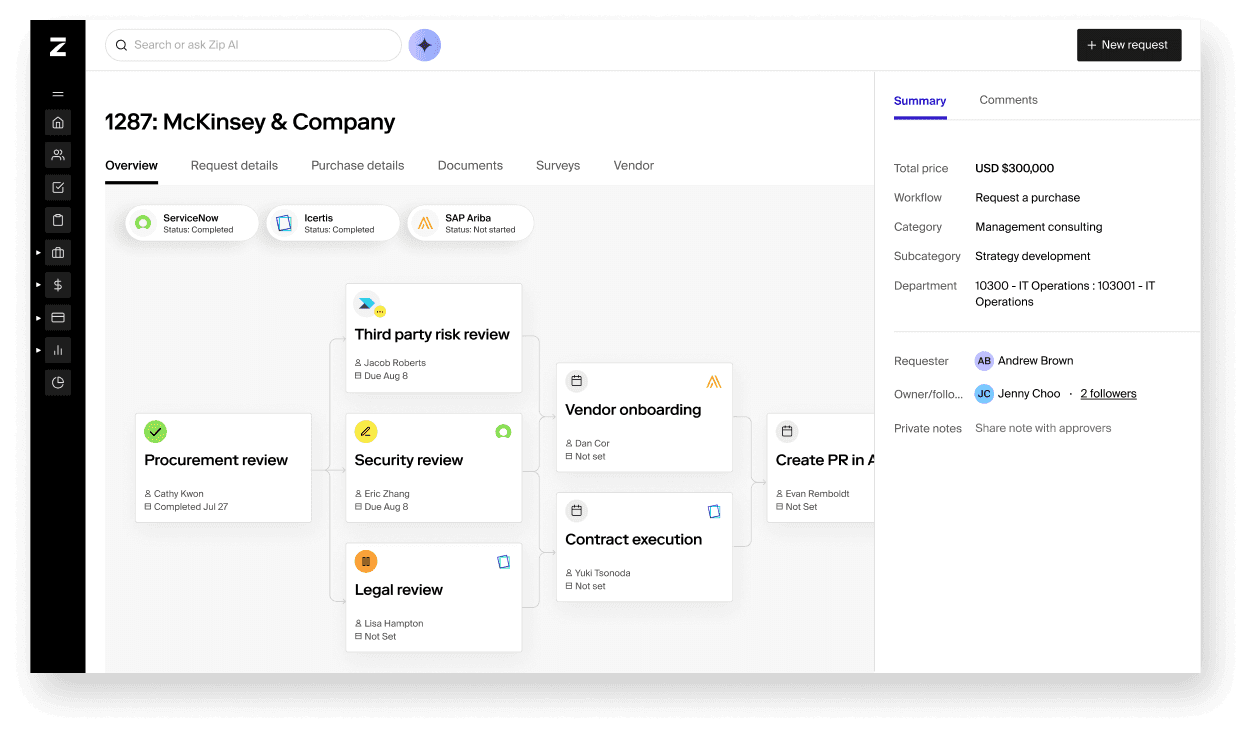
This is Zip's core. Employees get a single "front door" to request software, services or suppliers. Instead of an email to procurement or a message in Slack, the request goes through a guided form that asks for the right details based on what's being bought.
Cross-team approvals
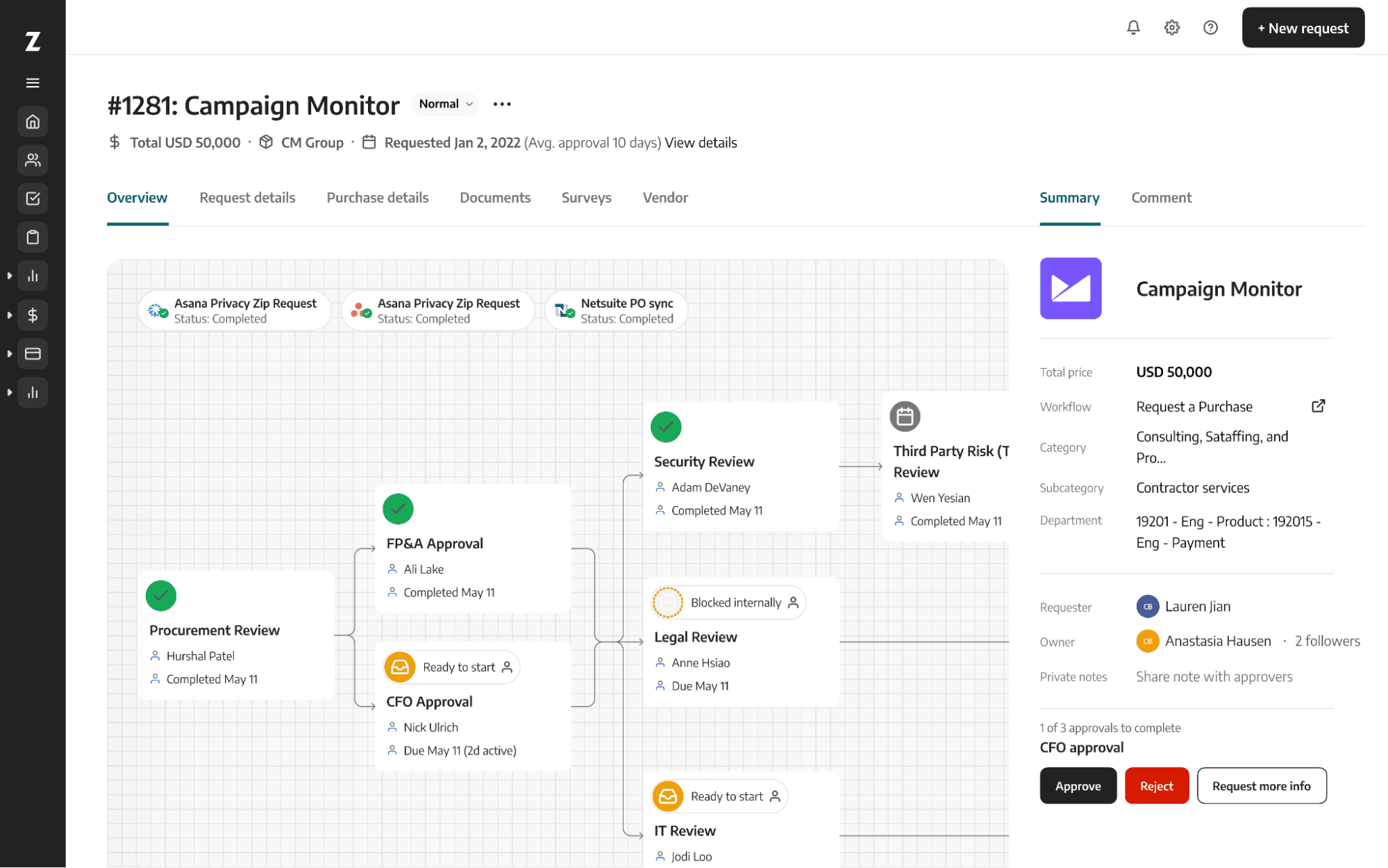
Once a request is in, Zip routes it for approval across procurement, finance, IT, data security, legal and other teams. Approvers can act from tools like Slack and Microsoft Teams, so they don't need to log in to yet another system.
Supplier onboarding and risk
Zip includes a supplier portal for collecting vendor documents and records. In 2025, it added Zip for Risk Orchestration, which applies the same workflow approach to compliance and risk reviews.
Contracts
In April 2026, Zip launched AI Contract Orchestration, which automates parts of supplier contract review, negotiation and compliance.
Purchase orders, invoices and payments
When a request is approved, Zip creates a purchase requisition or draft PO in your ERP or P2P system. In May 2026, it moved further downstream with AI Automation for Procure-to-Pay, a set of agents for accounting work from purchase request through to payment.
Sourcing
Zip also offers sourcing tools, including RFx, for teams that run competitive bids.
Zip's key features
No-code workflows
Admins build intake forms and approval paths without engineering help. This is one of the things reviewers mention most often.
AI agents and Superagents
In June 2025, Zip launched 50+ AI agents, each built for a specific task such as validating data, scanning contracts or flagging policy risk. It also released a no-code agent builder so customers can create their own.
A year later, in June 2026, it introduced five Superagents that take on broader workflows:
- Procurement Superagent: unblocks stalled requests, handles tail-spend negotiation and manages follow-ups within policy
- Contract Superagent: reviews contracts against approved playbooks and escalates high-risk issues to legal
- AP Superagent: sorts, codes, matches and routes invoices
- Config Superagent: spots workflow bottlenecks and drafts configuration changes for admins
- Intake Superagent: helps employees create compliant requests and prefills required fields
Zip launched the Superagents in beta, with general availability planned for later.
Zip MCP
Zip MCP connects Zip to AI assistants such as Claude and ChatGPT, so employees can raise a request or pull a report from the assistant they already use. Zip says actions respect user permissions and leave a full audit trail.
Integrations
Zip connects to 20+ third-party tools, including NetSuite, Workday Financial Management, SAP S/4HANA Cloud, Oracle Fusion Cloud ERP, Coupa, SAP Ariba, ServiceNow, Slack, Microsoft Teams, Jira and Okta.
Add-on modules
Some capabilities are sold separately. According to SoftwareConnect, these include budget tracking, virtual cards and international payments.
Why companies choose Zip
So why do so many procurement teams land on Zip? From its reviews and analyst coverage, four reasons come up again and again.
- Employees actually use it. Reviewers regularly praise how easy the request experience is for non-procurement staff, which matters when the whole model depends on people using the front door.
- It covers a lot of ground. Zip now spans intake, approvals, contracts, sourcing and P2P, so large teams can consolidate several tools.
- It fits into the existing stack. Zip works alongside your current ERP and P2P tools rather than replacing them.
- It's a proven, well-referenced vendor. IDC described Zip as a "category-defining platform with the largest spend orchestration reference base," and it holds a 4.6 out of 5 rating on G2.
Where Zip may not be the right fit
None of this makes Zip a bad product. It's built for a particular kind of buyer, and that buyer usually looks like a large enterprise with a dedicated procurement team. If that's not you, here's what to weigh up.
Built procurement-first, at enterprise scale
Zip's reference customers are names like OpenAI, AMD and T-Mobile. Its newest enterprise offering, AI Spend Automation, pairs the platform with Zip's own forward-deployed engineers who build custom agents inside the customer's environment. That's a great model for a Fortune 500 procurement org. For a 400-person company where the Controller is also, unofficially, the procurement team, it can be more platform than you need.
Implementation takes time
G2 reviewers report an average time to implement of about three months, and SoftwareConnect lists lengthy implementation as a con. Three months isn't long by legacy source-to-pay standards. It's still a quarter of configuration before you see value.
Pricing isn't public
Zip doesn't publish pricing, and there's no free trial. Every plan is a custom quote, some modules are add-ons, and the AI Spend Automation offering bundles AI consumption credits. That makes it harder to forecast total cost before you're deep into a sales cycle.
The front door only works when people use it
Zip's model starts when an employee submits a request. It's been bringing that door closer to where people work (Slack, Teams and now AI assistants), which helps. But for mid-market teams, a lot of spend still starts as an email to a vendor or a quick message to a manager, long before anyone opens a request form. Capterra's review summary also notes that complex requirements, large request volumes and inconsistent integrations can make daily use harder for some users.
Zip vs Blackbee AI
Zip and Blackbee AI both use AI agents, and both sit above your ERP instead of replacing it. Where we differ is who we're built for and where the controls kick in.
Blackbee AI is an agentic Intake-to-Pay platform for mid-market finance teams. It picks up spend intent at its source (emails, chats, Teams and more), then governs commitment, contracts, approvals and invoices until clean, structured data hits your ERP. Of course, every one of those steps is within your explicit control. You choose what Blackbee AI handles, and it does only that, and does it well.
| Criteria | Zip | Blackbee AI |
|---|---|---|
| Category | Procurement orchestration and source-to-pay | Agentic Intake-to-Pay platform |
| Built for | Enterprise procurement teams | Mid-market finance teams (200–2,500 employees) |
| Primary buyer | CPO and procurement operations | CFO, Controller, VP Finance, AP Manager and Procurement Leader |
| Where intake starts | A single front door for requests, also reachable from Slack, Teams and AI assistants | Spend intent captured where it surfaces: email, chat, Teams |
| AI approach | 50+ task agents, five Superagents, a no-code agent builder, plus forward-deployed engineers on the enterprise tier | Eight specialist agents supported by sub-agents, with every decision explained and confidence-scored |
| Contracts | AI Contract Orchestration for review and negotiation | Clause Agent turns contract terms into live financial guardrails that invoices are checked against |
| Approvals | Configurable cross-team approval workflows | Route Agent routes approvals by risk and policy, not just amount |
| ERP posture | Integrates with NetSuite, Workday, SAP, Oracle and more | Works above NetSuite, Sage Intacct, Dynamics 365, Workday and SAP, posting validated decisions back |
| Pricing | Quote-based, with add-on modules and AI credits on the enterprise tier | Priced on control across three tiers, with no per-invoice fees |
So which is right for you? If you run a large, dedicated procurement function and want one platform for sourcing through payment, Zip is a strong option and worth a look. If you're a mid-market finance team on NetSuite, Sage Intacct, Dynamics 365, Workday or SAP, and you want governance to start the moment someone signals they need to spend, that's exactly what we built Blackbee AI for.
See how Blackbee AI governs spend from intent to payment
FAQs
What is Zip used for?
Zip is used to manage procurement requests from start to finish. Employees submit purchase requests through one intake point, and Zip routes them through approvals across finance, legal, IT and security, then pushes approved purchases into the company's ERP or P2P system. It has since added contracts, sourcing, supplier risk and invoice-processing agents.
Is Zip the same as Zip Co or Zip Pay?
No. Zip (zip.com, also ziphq.com) is a San Francisco-based procurement software company. Zip Co is a separate, unrelated buy-now-pay-later provider.
Who founded Zip?
Zip was co-founded in 2020 by Rujul Zaparde, who is CEO, and Lu Cheng, who is CTO. The company is privately held and backed by investors including BOND, Y Combinator and CRV.
How much does Zip cost?
Zip doesn't publish pricing. Plans are quote-based, some features are sold as add-on modules, and there's no free trial. You'll need to request a demo for a quote.
How long does Zip take to implement?
G2 reviewers report an average implementation time of around three months. Timelines vary with the number of workflows, integrations and teams involved.
What ERPs does Zip integrate with?
Zip lists integrations with NetSuite, Workday Financial Management, SAP S/4HANA Cloud and Oracle Fusion Cloud ERP, along with P2P tools like Coupa and SAP Ariba.
What's the difference between Zip and Blackbee AI?
Zip is a procurement orchestration platform built mainly for enterprise procurement teams, starting at a request front door. Blackbee AI is an agentic Intake-to-Pay platform built for mid-market finance teams. It captures spend intent where it surfaces, turns contract terms into live guardrails, routes approvals by risk and policy, and posts validated decisions back to your ERP. It's priced on control, with no per-invoice fees.
What are the best Zip alternatives?
It depends on your size and priorities. Large enterprises often compare Zip with source-to-pay suites like Coupa or Ivalua. Mid-market finance teams that want governance from spend intent through to payment, sitting above NetSuite, Sage Intacct, Dynamics 365, Workday or SAP, often look at Blackbee AI.
Summary
Zip is a well-funded, analyst-recognised procurement orchestration platform. It's used for intake, cross-team approvals, supplier onboarding, contracts, sourcing and, increasingly, AP. It's a strong fit for large enterprises with dedicated procurement teams and the time to configure it.
If you're a mid-market finance team and you want control to start at spend intent, with every decision explained, Blackbee AI is built for you. You stay in charge of what it handles, and your ERP stays your system of record.
Book a 30-minute demo
Gartner and Magic Quadrant are trademarks of Gartner, Inc. and/or its affiliates.