What Is Shadow Spend? The Finance Leader's Guide
Shadow spend is money committed outside your approved buying process. Learn where it hides in 2026, what it costs, and how to stop it at spend intent.
Every finance team has a number it trusts. Usually it's total spend for the month, or budget vs actuals. The trouble is that a good chunk of the money behind that number was committed by people who never asked anyone first.
A marketing manager signs up for an AI writing tool on her personal card and expenses it. An engineering lead renews a SaaS contract because the auto-renewal email landed in his inbox and nobody else saw it. A plant manager calls a supplier he likes and gets the parts delivered. Then he asks procurement to raise a PO afterward so the invoice can get paid. Each one of these looks small. Added up across a year, they are a budget line you never approved.
That is shadow spend. And in 2026, with AI tools getting bought on credit cards faster than IT can list them, it is growing quicker than most finance teams realise. Zylo's 2026 SaaS Management Index found that expense-based software spend jumped 267% year over year, and ChatGPT is now the single most expensed app in the companies it tracks.
This guide walks through what shadow spend is, where it hides, what it costs you, and how to stop it at the moment someone decides to spend, well before an invoice shows up.
What is shadow spend?
Shadow spend is any money your company commits outside its approved buying process. It covers purchases made without a request, without an approval, without a PO, or outside a negotiated contract. The money still leaves the business. Finance just finds out late, usually when the invoice or the card statement arrives.
The term borrows from shadow IT, which describes software and devices people use without IT's sign-off. Shadow spend is the money side of that same habit, and it goes well beyond software. Office fit-outs, contractors, marketing agencies, lab supplies and freight all end up in it.
The scale is big. Gartner predicts that by 2027, 75% of employees will acquire, modify or create technology outside IT's visibility, up from 41% in 2022. Every one of those tools has a price tag attached, and someone in finance ends up paying it.
A quick way to spot it: if the first time finance hears about a commitment is when the bill arrives, that commitment was shadow spend.
Shadow spend vs maverick spend vs tail spend
These three terms get used as if they mean the same thing. They overlap, but they describe different problems, and each one needs a different fix.
| Term | What it means | Who usually causes it | Typical example |
|---|---|---|---|
| Shadow spend | Any commitment finance can't see until after the money is owed | Anyone with a company card or a supplier's phone number | A team buys an AI tool on a personal card and expenses it |
| Maverick spend | Buying outside an agreed contract or preferred supplier, even when the process is known | Employees who know the rules and go around them | Ordering laptops from a retailer when you have a negotiated hardware deal |
| Tail spend | The long list of small, infrequent suppliers that procurement rarely manages | Nobody in particular, it builds up over time | Hundreds of one-off vendors that each bill a few thousand a year |
Tail spend is a big part of the story. The Hackett Group's 2025 tail spend study puts it at roughly 20% of enterprise spend spread across 80% of suppliers, and only 4% of companies actively manage most of it.
Maverick spend is the subset where someone knew there was a contract and bought elsewhere anyway. Shadow spend is the wider umbrella. It includes both of the above, plus anything that was committed before finance or procurement knew it existed.
Where shadow spend hides in 2026
Shadow spend shows up in a few predictable places. If you know where to look, you can usually find most of it within a week.
1. Shadow AI tools
This is the fastest-growing category by a long way. The 2024 Microsoft and LinkedIn Work Trend Index found that 78% of AI users bring their own AI tools to work. MIT's research on the "shadow AI economy" went further: 90% of employees regularly use personal AI tools for work, while only 40% of their companies have bought official subscriptions.
Each of those personal accounts is a small monthly charge. Spread across a few hundred people, that's a software budget nobody signed off on. Zylo also found that AI app spend rose 108% across all organisations in a single year.
2. Shadow SaaS
Before AI, SaaS was the main culprit, and it still is a big one. Torii's 2026 SaaS Benchmark Report found that 61.3% of all apps discovered in enterprise environments qualify as shadow IT, and only 15.5% are formally sanctioned. The average enterprise runs around 830 apps.
Auto-renewals make this worse. A tool someone tried once in 2024 can quietly renew at a higher tier in 2026 because the notice period passed and nobody was watching.
3. Corporate cards and expense reports
Cards are meant to make small purchases easy, which they do. They also make it easy to split a large purchase into a few smaller ones that each stay under the approval limit. Expense reports hide software subscriptions in the same way, coded as "office supplies" or "miscellaneous".
4. Off-contract buying
You negotiated a rate with a preferred supplier. Someone buys the same item from a different supplier at a higher price, or from the right supplier at the wrong price. Either way, the savings procurement worked hard for never show up. Ardent Partners' 2025 research found that best-in-class teams achieve 79.5% contract compliance, while everyone else sits at 56.2%. That gap is money.
5. After-the-fact POs
This one hides in plain sight. Goods or services are delivered first, and a PO gets raised afterwards so the invoice can match and get paid. On paper the purchase looks compliant. In reality nobody approved it before it was committed. UCSF's supply chain team describes these clearly in their guide to after-the-fact POs. As they point out, bypassing the normal process skips safeguards like separation of duties and data safety checks.
What shadow spend actually costs you
The invoice amount is the smallest part of the cost. The bigger damage comes from what you lose by not knowing about it in time.
| Cost | What happens | The data |
|---|---|---|
| Lost negotiated savings | Purchases skip the contract, so you pay list price | Each extra dollar brought under management yields 6% to 12% savings in the first contract period (Ardent Partners) |
| Wasted licences | Duplicate tools and forgotten subscriptions keep billing | Organisations leave 36% of SaaS licences unused on average (Zylo) |
| Surprise bills | Usage-based and AI pricing scales without a cap | 78% of IT leaders reported unexpected charges from consumption or AI pricing in the past 12 months |
| Security and data risk | Unvetted tools handle company data | One in five organisations had a breach due to shadow AI, and high shadow AI use added $670,000 to the average breach cost (IBM) |
| Fraud exposure | Vendors get paid without onboarding checks | Billing schemes make up 22% of occupational fraud cases, with a median loss of $100,000 (ACFE) |
There's a softer cost too. When a big share of spend sits outside the process, your forecasts are built on partial data. You can't plan cash well when part of next quarter's commitments are sitting in someone's inbox.
The good news is that procurement teams are getting better at this. Ardent Partners reports that the average team now manages about 71% of enterprise spend, the first time that figure has passed 70% in two decades of research. Best-in-class teams manage 91.7%. For most mid-market companies, that still leaves somewhere between a tenth and a third of spend in the shadows.
Why shadow spend starts before the PO
Most finance tools are built around the invoice. The invoice comes in, it gets matched against a PO and a receipt, it gets approved, and it gets paid. That's a good process for catching errors in a bill. It does very little for shadow spend, because by the time the invoice lands, the money is already committed.
Think about where a purchase actually begins. Someone has a need. They mention it in a Slack thread or a Teams chat, email a supplier they already know, or click "start free trial" on a website and put a card in. That moment, the spend intent, is where the decision gets made. Everything after it is paperwork catching up.
If your controls only kick in at the PO or the invoice, you are reviewing decisions that have already happened. You can reject the invoice, but the supplier has already delivered and the contract is signed. So most teams pay it and move on, and the shadow spend becomes normal spend in next year's budget.
That's the gap Intake-to-Pay is designed to close. It moves the control point upstream to where the intent is first expressed, so finance sees the request while there's still a real choice to make.
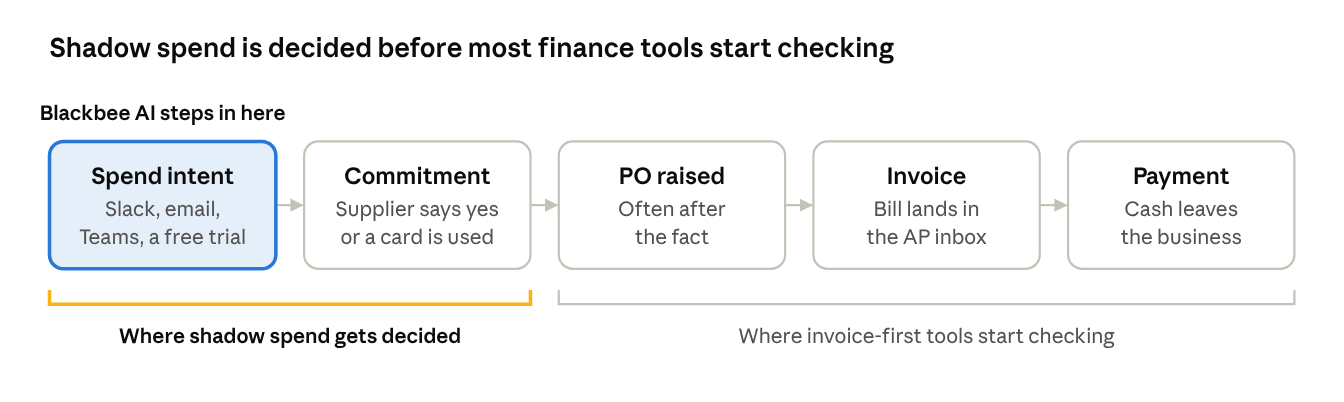
By the time a PO or invoice exists, the decision to spend has already been made upstream.
How to find shadow spend in your own data
You don't need new software to get a first read on how much shadow spend you have. You need a few exports and an afternoon. Here's the order we'd go in.
- 1.Pull every invoice paid without a PO. In most ERPs this is a simple filter. Sort by vendor and total. The vendors at the top of that list are where your biggest gaps are.
- 2.Find your after-the-fact POs. Compare PO creation dates against invoice dates or delivery dates. Any PO raised after the goods arrived is a commitment nobody approved in advance. Track this as a percentage of all POs each month. It's one of the best early warning signs you have.
- 3.Search card and expense data for software. Look for merchant names like OpenAI, Anthropic, Notion, Canva, Zoom and Figma, plus anything coded to "software" or "miscellaneous". Group by merchant and count how many different people are paying for the same tool.
- 4.Check your vendor master for duplicates. The same supplier often appears two or more times under slightly different names. That splits your spend data and hides how much you actually spend with them.
- 5.Match invoices to contracts. For your top 20 suppliers by spend, compare the prices on recent invoices to the contracted rates. Any difference is either off-contract buying or a supplier billing above the agreed price, and both are worth knowing about.
- 6.Calculate your spend under management. Divide the spend that went through an approved process by total spend. ISM defines spend under management as the percentage of a company's spend that is actively managed and controlled by procurement. Whatever is left over is your shadow spend estimate.
This gives you a baseline. The catch is that it's a look backwards. Every number here is money that's already gone, which is why the real fix has to happen earlier.
How Blackbee AI stops shadow spend at the source
Blackbee AI is an agentic Intake-to-Pay platform that sits above your ERP. It starts at spend intent, the moment someone decides they need something, and stays with that request all the way until clean, structured data lands in your ERP. Eight specialist AI agents each handle one part of that journey. For shadow spend, a few of them do most of the heavy lifting.
The Intake Agent catches requests wherever they happen. That includes emails, Slack, Teams, forms and chat. People don't need to learn a new portal or remember a process. They ask the way they already ask, and the request gets captured and checked against policy before anything is committed. When the approved path is this easy, people stop looking for a way around it.
The Contract Intelligence Agent turns your contracts into live guardrails. It reads the pricing and renewal terms in each agreement, then flags a request that should go to a contracted supplier, or an invoice that's billing above the agreed rate. Auto-renewals get surfaced well before the notice window closes.
The Approval Orchestration Agent routes approvals by risk. A $200 renewal of a tool you already use moves fast. A new AI vendor that will touch customer data goes to the right people, whatever the amount. Approvals stop being a bottleneck, which removes one of the main reasons people skip them.
The Vendor Relations Agent makes sure nobody gets paid before they're vetted. New suppliers get onboarded and risk scored before the first PO, so a shadow vendor never makes it into your payment run.
The Spend Intelligence Agent watches for what slips through anyway. It spots split purchases, duplicate tools, new merchants on card statements and spend that's drifting off contract, and it flags them while they're still small.
Of course, all of this sits within your explicit control. You choose which steps Blackbee AI handles, and it does only those, and does them well. Your ERP stays your system of record. Blackbee AI is the decision and control layer above it, so every commitment is seen and approved before it turns into an invoice you have to chase.
See where your shadow spend is hiding
Shadow spend grows quietly because every single purchase looks too small to matter. The fix is to see the request at the moment someone decides to spend, and give them an approved path that's easier than the workaround.
If you'd like to see how Blackbee AI does that on top of your ERP, book a demo and we'll walk through it with your own spend scenarios.
Related reading: Spend Intelligence 101 · AI Vendor Risk Scoring